Renewable energy project development

Australia has set a target of 82% renewable energy by 2030. Large-scale renewable projects can take years to progress from an idea to operation. Project development is complex, with many stages and activities involved.

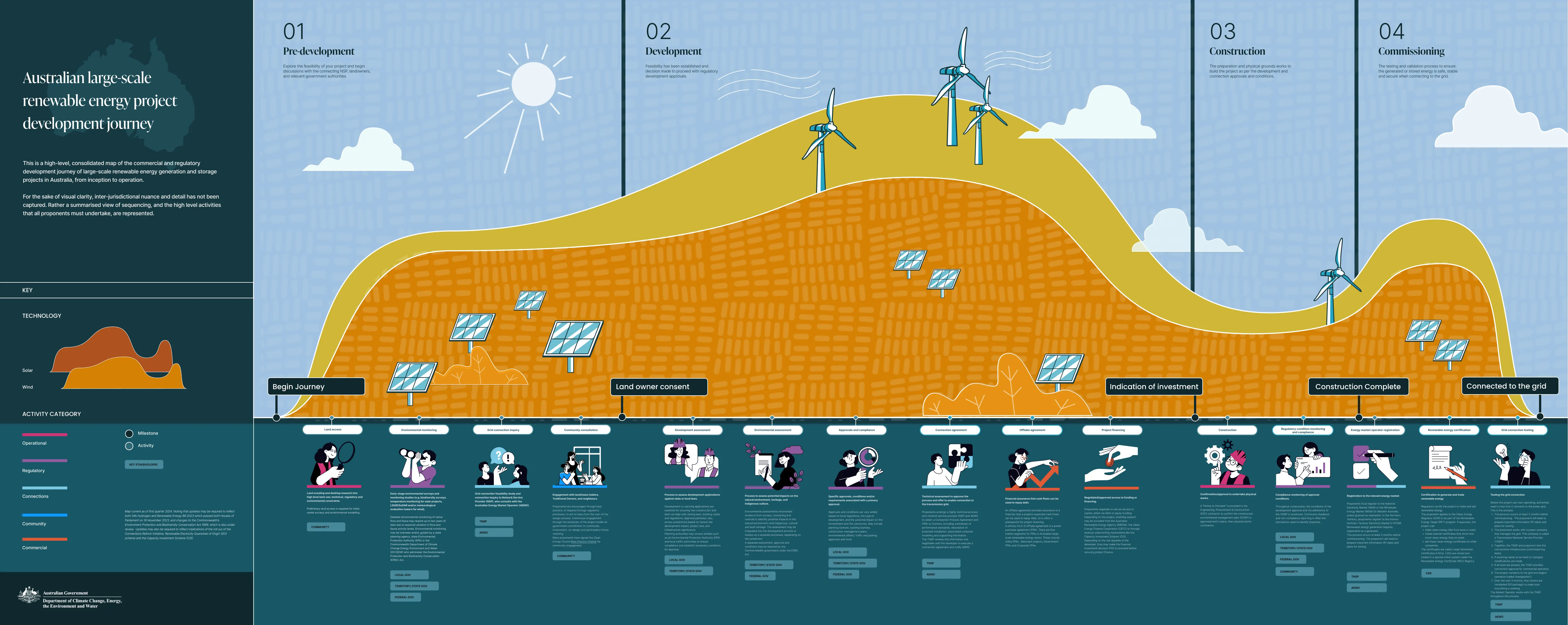
Through the National Energy Transformation Partnership, the Energy and Climate Change Ministerial Council has facilitated this high-level development pathway for large-scale solar and wind projects in Australia.

The development pathway can help communities and stakeholders better understand what's involved in renewable energy development. It covers a renewable project up to operation, showing the journey for projects in the pipeline, but not yet in operation. It focuses on the commercial and regulatory processes for these renewable energy projects, before they become operational.

Sections within each stage summarise the major tasks required to progress a project through the development pathway. This is a simplified national view of the renewable energy development pathway so does not show all the differences between states and territories.

Detailed development pathway

This page provides high-level details of each stage for a wind or solar project. Click or tap on the thumbnail to see detailed information about each stage. 

Thumbnail of user journey map
checkered flag icon

Milestone: begin journey

Stage 1: pre-development

Explore likely success of the project. Begin ongoing discussions with relevant parties.

Land access

Field and desktop research into site suitability

Early research into land use and regulatory requirements.

Preliminary land access may be required to commence onsite surveys and modelling. This may involve landowners and Traditional Owners.

Key stakeholders

  • Community
Land access icon. Operational activity.
Environmental monitoring icon. Regulatory activity.

Environmental monitoring

Early-stage environmental surveys and monitoring studies

Detailed monitoring of native flora and fauna for up to 2 years to account for seasonal variations.

Monitoring may be overseen or guided by a state or commonwealth agency to meet environmental assessment needs.

Key stakeholders

  • Local government
  • Territory/state government
  • Australian Government 

Grid connection inquiry

Grid connection studies and enquiries

Early studies on options and suitability to connect to the electricity grid.

Initial enquiry to the relevant Transmission Network Service Provider (TNSP) to connect to the grid. The TNSP consults with the Australian Energy Market Operator (AEMO), or if in the Northern Territory with the Northern Territory Electricity System and Market Operator (NTESMO), on the enquiry.

Key stakeholders

  • TNSP
  • AEMO
  • NTESMO
Grid connection inquiry. Connections activity.
Community consultation icon. Community activity

Community consultation

Stakeholders, Traditional Owners and communities consulted

Landowners, Traditional Owners and relevant communities engaged on proposed project.

Proponents should act on input from stakeholders at the start of the design process. It is good practice to continue to engage throughout the project.

Key stakeholders

  • Community

Stage 2: development

Confirm project can progress. Apply for development and environmental approvals.

Development assessment

Development applications assessed in line with state and local laws

Development or planning applications submitted to ensure the land use is lawful.

Authorities assess an application against relevant laws and provide an approval, if appropriate.

Approval pathways vary across states and territories.

Approval authorities can request other areas, such as an Environmental Protection Authority (EPA), to provide input to assessments.

An approval may include conditions to ensure compliance against the relevant law.

Key stakeholders

  • Local government
  • Territory/state government
Development assessment icon. Regulatory activity
Environmental assessment icon. Regulatory activity.

Environmental assessment

Applications assessed to check impact on environment and cultural heritage

Applications submitted to ensure environmental and cultural impacts are minimised and in line with relevant laws.

Experts carry out environmental and heritage tests. This may include surveys and monitoring to identify if the project will impact the environment or cultural heritage.

Environmental and cultural heritage requirements are different for each state and territory. Assessments may be part of a development application or a separate process.

In some cases, the Australian Government requires a separate assessment under the Environment Protection and Biodiversity Conservation Act 1999.

Key stakeholders

  • Territory/state government
  • Australian Government

Approvals and compliance

Conditions for a primary approval

Relevant conditions linked to an approval.

Many approvals have specific conditions. Conditions may be different for each state and territory. This is because of differing local regulations and the type of development.

Conditions or other approvals may include:

  • Planning licences
  • Building licences
  • Construction Management Plans
  • Environmental Offsets
  • Traffic Management Plans.

Key stakeholders

  • Local government
  • Territory/state Government
  • Australian Government
Approvals and compliance icon. Regulatory activity
Connection agreement icons. Connections activity

Connection agreement 

Agreement to connect the project to the electricity grid

Technical process with the Transmission Network Service Provider (TNSP) and the Australian Energy Market Operator, or if in the Northern Territory with the Northern Territory Electricity System and Market Operator (NTESMO).

Proponents submit performance standards, a description of proposed installations and associated computer modelling.

The TNSP checks this information and negotiates with the proponent. The desired outcome of this process is a:

  • Connection Agreement
  • Offer to Connect.

Key stakeholders

  • TNSP
  • AEMO
Offtake agreement icon. Commercial activity.

Offtake agreement

Financial assurance that cash flows can repay debt

Provides assurance to a bank that a project’s cash flows can repay debt.

An offtake agreement is often a prerequisite for project financing. A primary form of offtake agreement is a Power Purchase Agreement (PPA).

There are 4 PPAs in Australia’s large-scale renewable energy sector:

  • Utility PPAs
  • Merchant PPAs
  • Government PPAs
  • Corporate PPAs.

Project financing 

Negotiated access to funding or financing

Access to capital for project financing is secured.

Proponents can:

  • borrow money (debt)
  • sell part of their project (equity).

In Australia, support may be provided through the:

  • Australian Renewable Energy Agency
  • Clean Energy Finance Corporation
  • Capacity Investment Scheme.

In some cases, a financial investment decision (FID) occurs before securing project finance. This decision will depend on the risk appetite of the proponent.

Project funding icon. Commercial activity.
checkered flag icon

Milestone: indication of investment

Stage 3: construction

Carry out physical works to build the project as per approvals and conditions.

Construction icon. Operational activity

Construction 

Approval to start physical works

Contracted works to build the project proceed.

The contractor is often an Engineering, Procurement and Construction (EPC) company.

Authorities approve a plan that shows how construction works will protect the environment. This is the construction environmental management plan (CEMP).

The EPC contractor then receives a 'Notice to Proceed' - the green light to start work.

Regulatory condition monitoring and compliance

Monitoring

Authorities track if proponents are following the conditions of their approvals.

Approvals and environmental plans are monitored to check agreed conditions are being met.

Community members may assist by reporting any problems with the project. 

Key stakeholders

  • Local government
  • Territory/state government
  • Australian Government
  • Community
Regulatory condition monitoring and compliance icon. Regulatory activity.
checkered flag icon

Milestone: construction complete

Stage 4: commissioning

Test to check the renewable energy from the project can connect to an existing electricity system or grid.

Energy market operator registration

Registration to the relevant energy market

Renewable energy project registered to participate in the relevant energy market.

Proponents must register to the National Electricity Market (NEM) or the Wholesale Energy Market (WEM) for Western Australia, unless granted an exemption. In the Northern Territory, proponents register to the Interim-Northern Territory Electricity Market (I-NTEM).

Renewable energy generation requires registration as a generator.

This process occurs at least 3 months before commissioning. The proponent will need to prepare important information (R1 data) and plans for testing.

Key stakeholders

  • TNSP
  • AEMO or NTESMO
AEMO registration icon - regulatory activity.
LGC accreditation icon. Commercial activity.

Renewable energy certification

Certification to generate and trade renewable energy

Regulators certify the project to make and sell renewable energy.

The proponent applies to the Clean Energy Regulator (CER) to be part of the Renewable Energy Target (RET) program. If approved, the project can:

  • make clean energy (like from wind or solar)
  • create special certificates that show how much clean energy they've made
  • sell these clean energy certificates to other companies.

The certificates are called Large Generation Certificates (LGCs). LGCs are stored and traded in a special online system called the Renewable Energy Certificate (REC) Registry.

Key stakeholders

  • CER

Grid connection testing

Testing the grid connection

Information and testing to connect the project to the grid.

Before the project can start operating, authorities need to test how it connects to the power grid. This is the process:

  1. This process occurs at least 3 months before commissioning.  The proponent will need to prepare important information (R1 data) and plans for testing.
  2. The proponent works with a power company that manages the grid. This company is called a Transmission Network Service Provider (TNSP).
  3. Together, the TNSP and proponent test the connections infrastructure (commissioning tests).
  4. If anything needs to be fixed or changed, modifications are made.
  5. If all tests are passed, the TNSP provides connection approval for commercial operation.
  6. The project connects to the grid and begins operation (called 'energisation').
  7. Over the next 3 months, final checks are completed (R2 package) to make sure everything is working.

The Australian Energy Market Operator (AEMO), or if in the Northern Territory the Northern Territory Electricity System and Market Operator (NTESMO), works with the TNSP throughout this process.

Key stakeholders

  • TNSP
  • AEMO or NTESMO
Grid connection testing icon. Connections activity.
checkered flag icon

Milestone: connected to the grid

Print

You can print the development pathway.