

Reef Trust programs across the Great Barrier Reef
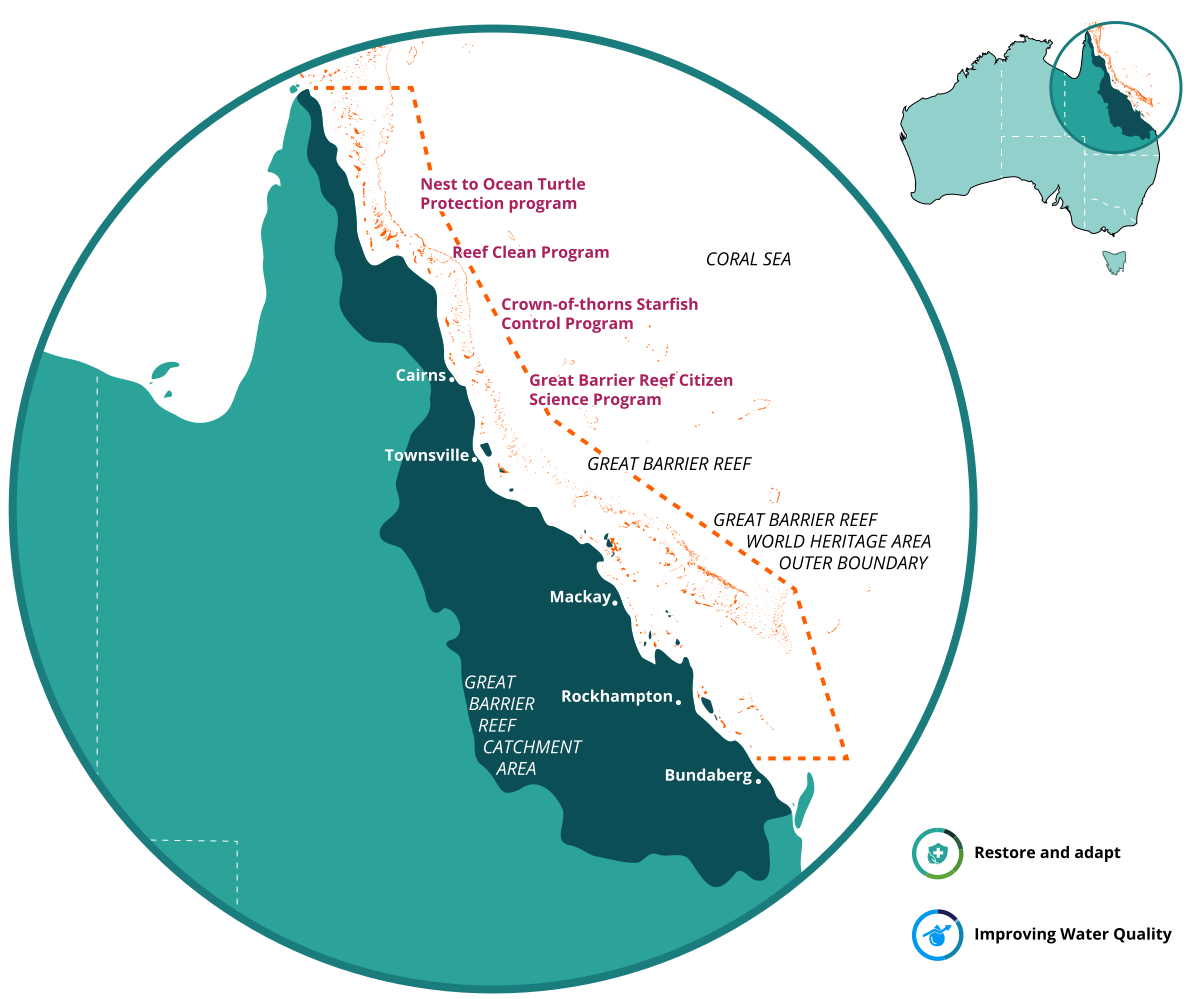
Select a marker on the map to read about the program or project at that location.
-
Nest to Ocean Turtle Protection program

The Nest to Ocean Turtle Protection program is protecting turtle eggs and turtle hatchlings from feral animals, like pigs and foxes.
The program uses innovative ideas, such as the use of thermal imaging and drones, to control feral pigs and other predators and increase the survivorship of marine turtle eggs and hatchlings.
Since 2014, more than 40,000 turtle nests have been monitored, and the program has consistently achieved greater than 90% nest survival through predator control activities and direct nest protection.
It is estimated that approximately 2.5 million hatchlings have been protected since the inception of the program.
The program is supported by funding through the Reef Trust. It is also funded by the Queensland Government.
Nest to Ocean Turtle Protection program (opens in a new window)
-
Tangaroa Blue ReefClean program

The Reef Clean Program organises beach clean-up events, delivers educational initiatives and collects valuable marine debris data.
Since the program began in 2019:
- more than 140 tonnes of marine debris has been removed
- more than 2.6 million marine debris items have been collected
- 18,000 volunteers have been involved in clean-up events.
Marine debris is recognised as one of the key threats for the Reef. It can threaten biodiversity, be lethal for marine life and impact on tourism.
ReefClean is funded by the Reef Trust.
ReefClean - Tangaroa Blue Foundation (opens in a new window)
-
Crown-of-thorns Starfish Control Innovation Program (CCIP)

The COTS Control Program continues to play a vital role in protecting coral across the Great Barrier Reef. Since 2012, it has protected coral across approximately 1 million hectares of reef habitat from this coral-eating pest.
The Reef Trust is supporting the COTS Control Program through funding for CCIP.
The CCIP is delivering new tools and innovations to enhance Australia’s world-leading approach to COTS management. It is helping the program to better predict, detect and respond to outbreaks.
Crown-of-thorns starfish control program | Reef Authority (opens in a new window)
-
Great Reef Census

The Great Reef Census is one of the largest ocean citizen science projects in the world.
Led by Citizens of the Reef, the Census mobilises tourists, divers and partners to capture images of the Reef, which are then analysed using cutting-edge AI and the power of thousands of volunteers. This helps to fill vital data gaps and strengthen existing monitoring programs.
Since the Census began:
- more than 25% of the Reef has been surveyed
- 740 reefs have been covered
- more than 15,000 people have been involved
- nearly 500,000 images have been analysed
The Census is one of four projects the Reef Trust is funding through the $4.3 million Great Barrier Reef Citizen Science Program.
-
Reef Restoration and Adaptation Program

The Reef Restoration and Adaptation Program (RRAP) is delivering breakthroughs in solutions to help coral reefs resist, adapt to and recover from the impacts of climate change.
This includes investigating solutions to help cool and shade areas of the Reef, as well as learning about and growing resilient corals that can better withstand the impacts of climate change.
The Pilot Deployments Program (PDP) is part of RRAP. The PDP is investigating and delivering solutions to deploy RRAP interventions at scale on the Great Barrier Reef.
Through the PDP, First Nations Rangers partnered with scientists during the 2025 mass coral spawning event to deliver the largest Reef restoration field testing activities to date.
This work involved knowledge building, gathering coral spawn and nurturing coral larvae. It culminated in millions of young corals being deployed back onto the Reef to support restoration efforts.
RRAP is funded by the partnership between the Reef Trust and the Great Barrier Reef Foundation. The PDP is delivered by the Australian Institute of Marine Science and funded by the Reef Trust.
Reef Restoration and Adaptation Program (opens in a new window)
-
Scaling Seagrass Restoration on the Great Barrier Reef

This project is expanding large-scale seagrass restoration across the Reef using a proven seed-based approach and strong Traditional Owner and community partnerships.
It is led by the Great Barrier Reef Foundation.
The project outcomes include:
- 2 new seagrass nurseries now operational in Gladstone and Airlie Beach.
- 208,585 seeds produced, harvested and stored.
- 73 people trained in seagrass monitoring and restoration.
- reseeding underway across the 400-hectare Rodds Bay meadow.
- over 3,500 seed filled “mud balls” deployed to restore degraded patches, helping strengthen seagrass resilience and support the health of the Reef.
This is one of 18 projects funded by the Reef Trust through the $28.5 million Reef Coastal Restoration Program.
Scaling Seagrass Restoration on the Great Barrier Reef (opens in a new window)
-
Reef Islands Initiative

The Reef Islands Initiative is the largest reef habitat rehabilitation project of its kind in the southern hemisphere.
The initiative includes on-land and in-water restoration efforts to protect and restore Reef Islands in the face of a changing climate. This includes at Lady Elliot Island, the Whitsundays and Avoid Island.
At Lady Elliot Island, the initiative has helped critical turtle nesting habitat increase by 125%.
The initiative is led by the Great Barrier Reef Foundation with funding support from the Reef Trust, Queensland Government, Lendlease and the Fitzgerald Family Foundation.
-
Reef Guardian Council Program

Through the Reef Guardian Council Program led by the Great Barrier Reef Marine Park Authority, local governments are delivering key management actions that address the threats facing the Reef and its heritage values.
The program continues to deliver tangible, high-impact outcomes for the Great Barrier Reef and its catchments. This includes projects that are boosting fish populations, improving water quality at the source and safeguarding endangered coastal habitats.
The program demonstrates a commitment to local economic health and global environmental stewardship.
The program is supported by Reef Trust funding.
-
Reef catchments Landscape Repair Program

This program is improving water quality by reducing sediment run-off. This is providing co-benefits for land productivity and healthy waterways across the catchment.
The program has a local target of reducing 18 kilotonnes of fine sediment loss from the MWI region by June 2030.
Work completed in 2025 alone is estimated to prevent approximately 4,682 tonne/year of fine sediment from entering the Reef Lagoon. This work included remediating land, planting more than 32,000 native plants and commencing a range of streambank fencing and grazing land management projects. This is one of 5 projects funded through the broader Reef Trust $200m Landscape Repair Program.
Landscape Repair Program - Reef Catchments (opens in a new window)
-
Upscaling oyster reef and mangrove restoration in GBR catchments

This project is improving habitat conditions and enhancing stewardship of tropical waterways and wetlands.
Led by OzFish Unlimited, the program of work includes:
- improving water quality and increasing biodiversity in tropical waterways
- establishing shellfish recycling and restoration manufacturing centres
- undertaking oyster reef and mangrove restoration
- working closely with recreational fishers and the broader community.
This is one of three projects funded by the Reef Trust through round 1 of the Community Stewardship Program.
Community Stewardship Program round 1 - DCCEEW (opens in a new window)
-
Scaling Seagrass Restoration on the Great Barrier Reef
This project is expanding large-scale seagrass restoration across the Reef using a proven seed-based approach and strong Traditional Owner and community partnerships.
It is led by the Great Barrier Reef Foundation.
The project outcomes include:
- 2 new seagrass nurseries now operational in Gladstone and Airlie Beach.
- 208,585 seeds produced, harvested and stored.
- 73 people trained in seagrass monitoring and restoration.
- reseeding underway across the 400-hectare Rodds Bay meadow.
- over 3,500 seed filled “mud balls” deployed to restore degraded patches, helping strengthen seagrass resilience and support the health of the Reef.
This is one of 18 projects funded by the Reef Trust through the $28.5 million Reef Coastal Restoration Program.
Scaling Seagrass Restoration on the Great Barrier Reef (opens in a new window)
-
Burnett Mary Regional Group Landscape Repair Program

This is the Burnett Mary Regional Group’s flagship sediment reduction initiative. It is repairing riverine streambank erosion across the Burnett Mary region.
This is supporting water quality improvements, agricultural productivity and Traditional Owner Partnerships. It is also restoring and protecting habitats for threatened species.
The program aims to prevent 18,000 tonnes/year of fine sediment entering the Great Barrier Reef. It is restoring native riparian vegetation and aquatic habitat. This includes habitats for threatened freshwater species, such as the White-throated snapping turtle, Mary River Turtle and the Australian lungfish.
The program is improving the long-term health of the Reef catchment and delivering significant benefits for land productivity.
It is one of 5 projects funded through the Reef Trust’s $200m Landscape Repair Program.
 Nest to Ocean Turtle Protection program
 Reef Clean Program
 Crown-of-thorns Starfish Control Program
 Great Barrier Reef Citizen Science Program
 Restore and adapt
 Improving Water Quality
Disclaimer: Locations are approximate. Some Reef Trust programs and projects are delivered in multiple locations across the Reef region.
