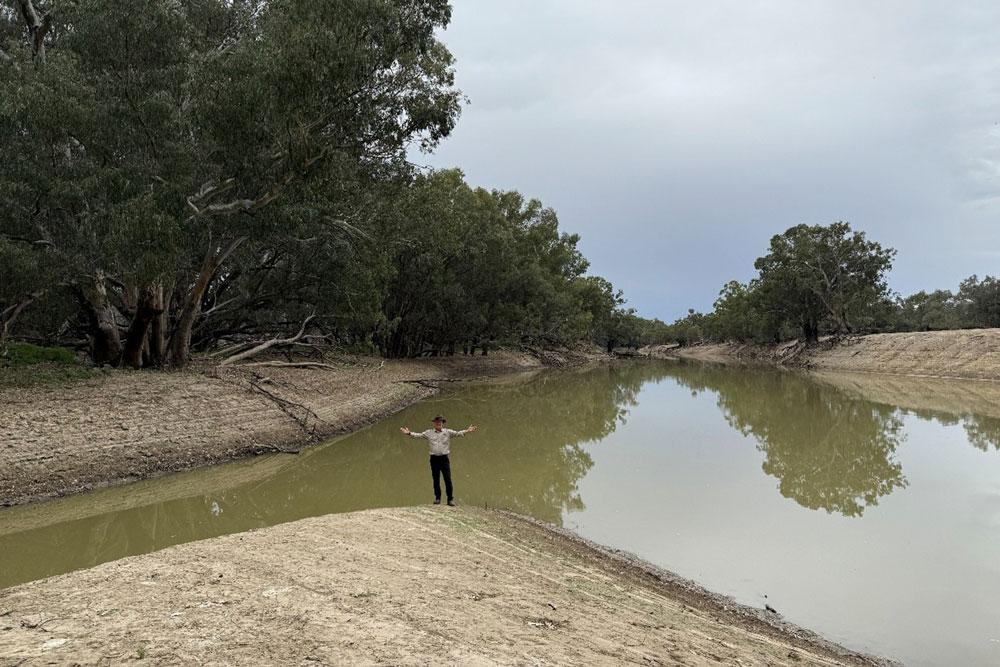
Dr Simon Banks at the junction of the Warrego and Darling rivers in November 2025.
In this op-ed, Dr Simon Banks, the Commonwealth Environmental Water Holder, explains how environmental water underpins the Murray–Darling Basin’s resilience as climate pressures intensify and new approaches guide water delivery across rivers and wetlands.
The Murray–Darling Basin’s rivers and wetlands are more than waterways—they are the lifeblood of ecosystems, communities, and cultures. Protecting and restoring them in a changing climate is one of the greatest environmental challenges of our time, especially across the huge scale of 1 million square kilometres of the Basin. That’s why the Commonwealth Environmental Water Holder (CEWH) is committed to ensuring every drop of our water delivers maximum benefit for nature and people.
Our work is internationally unique. We manage a vast public asset—Commonwealth water for the environment—on behalf of all Australians. This is not just about moving water; it’s about restoring resilience to rivers and wetlands that sustain biodiversity, agriculture and communities. Since our first water delivery in 2009, we’ve faced extremes: crippling droughts that threatened irreversible damage and floods that impacted Basin communities as well as offering rare opportunities for renewal. Through these challenges, we’ve learned, adapted and proven that environmental water works, achieving results for the environment and the people who rely on it.
In dry years, our role is critical. We prevent ecological collapse by keeping key wetlands alive and supporting native fish survival. In wet years, we amplify nature’s own rhythms, enabling large-scale breeding events for waterbirds and native fish. These outcomes are backed by science and monitoring and informed by real-time local knowledge. We also embed First Nations knowledges and collaborate with local communities, because healthy rivers are a shared responsibility.
Looking forward, persistence and innovation will continue to define our approach. Climate change is reshaping water availability and variability influencing runoff and drought projections, so we must stay on the path to be smarter and more strategic. Our preparations for a hotter and drier future will give us the greatest chance to build resilient ecosystems in both wet and dry times. Assisting the environment and communities to adapt to climate change will be essential if connectivity between rivers and the floodplain reduces further and poor water quality events occur more often. That means integrating delivery, carryover, and trade to optimise environmental outcomes at a whole-of-basin scale. Delivering water for the environment is essential alongside investment in complementary actions—like habitat restoration—that boost the impact of water delivery. Continuing to harness science, including First Nations knowledges, to guide decisions and share information widely is fundamental to the success of environmental water delivery.
Commonwealth Environmental Water Holder Dr Simon Banks.
Partnerships are at the heart of this work. We collaborate with landholders, state agencies, First Nations, non-government organisations, irrigators, scientists, and community groups. Together, we can achieve more than any one organisation alone. As the only organisation delivering water for the environment with a Basin-wide perspective, we have unique insights – and responsibility – to advocate for policy reform and strengthen the Basin Plan, ensuring water for the environment remains a cornerstone of sustainable water management.
We are proud of our results since our inception. Since 2009, we have delivered 19,000 gigalitres of Commonwealth environmental water to 56 different ecosystem types. That’s the equivalent volume of 38 Sydney Harbours. We’ve supported more than 28,000 kilometres of waterways and more than 470,000 hectares of vital habitats revived. We’ve helped keep 11 Ramsar-listed wetlands resilient and supported threatened species like silver perch, Murray cod, and Murray hardyhead through critical life stages. Other positive impacts have been waterbirds nesting in greater numbers, and species like the southern bell frog reoccupying parts of their former range.
We take stewardship of our water portfolio seriously, striving to be a model water user and meeting all statutory obligations while pushing boundaries in environmental restoration. Our work is not just about rivers—it’s about communities, culture, and the future of Australia’s environment. We will continue to adapt our management of the portfolio to respond to climatic and environmental challenges and opportunities.
Our Strategic Plan 2026–30 sets out how we will deliver on our vision: Healthy rivers for healthy communities – valuing every drop. This vision is not aspirational; it drives every decision we make.
With sustained commitment, science and collaboration, we can keep our rivers healthy for generations to come.
Our new strategic plan outlines three key pillars for managing the Commonwealth environmental water portfolio:
Optimising management of environmental water holdings
Harnessing science and knowledge
Growing our partnerships.
These pillars will guide how we manage the Commonwealth’s water holdings to deliver long-term benefits for the Basin and the people who depend on it.