Skip to main content Skip to main navigation Skip to page navigation Skip to search
Home

Top navigation main

  • News & media
  • Jobs
  • Ministers
  • Contact us
Main menu

AWE Main

  • Climate change
    Climate change Driving climate action, science and innovation so we are ready for the future.
    • Climate science and adaptation
    • Australia's climate change action
    • Reducing emissions
    • Emissions reporting
    • International climate action
    • Climate Active
    • Climate change publications and data
    • Australia’s National Greenhouse Accounts (Emissions Data)
  • Energy
    Energy Building a secure and sustainable energy system for all Australians.
    • Australia's energy strategies and frameworks
    • Energy and Climate Change Ministerial Council
    • Renewable energy
    • Reducing transport emissions
    • Energy data
    • Energy efficiency
    • Energy markets
    • Energy programs
    • Energy security
    • Energy supply
    • Energy workforce
    • Women in energy
    • International activity
    • Energy publications
  • Environment
    Environment Improving stewardship and sustainable management of Australia’s environment.
    • Biodiversity
    • EPBC Act
    • Environment Information Australia
    • Environmental markets
    • International environment
    • Invasive species
    • Land
    • Marine
    • Protection
    • Report a breach of environment law
    • Threatened species & ecological communities
    • Waste and recycling
    • Wildlife trade
  • Water
    Water Improving the sustainable management of Australia’s water supply for industry, the environment and communities.
    • Coal, Coal seam gas (CSG) and water
    • Commonwealth Environmental Water Holder
    • National Water Grid
    • Water policy and resources
    • Wetlands
    • Publications
  • Parks and heritage
    Parks and heritage Managing Australia’s iconic national parks, historic places and living landscapes.
    • Australian Marine Parks
    • Australian National Botanic Gardens
    • Booderee National Park
    • Kakadu National Park
    • Christmas Island National Park
    • National parks
    • Norfolk Island National Park
    • Heritage
    • Pulu Keeling National Park
    • The Great Barrier Reef
    • Uluṟu-Kata Tjuṯa National Park
  • Science and research
    Science and research Undertaking research and collecting data to support informed decisions and policies.
    • Climate change
    • Australia's biological resources
    • Australian Biological Resource Study (ABRS)
    • Bird and bat banding
    • Supervising Scientist
  • About us
    About us We lead Australia’s response to climate change and sustainable energy use, and protect our environment, heritage and water.
    • Accountability and reporting
    • Assistance, grants and tenders
    • Contact us
    • Fees and charges
    • News and media
    • Publications
    • Our commitment to you
    • People and jobs
    • What we do
    • Who we are
    • Initiatives
  • Online services
    Online services We do business with you using online platforms. This makes it easier for you to meet your legal requirements.
Department of Climate Change, Energy, Enviroment and Water

Breadcrumb

  1. Home
  2. About us
  3. News and media
  4. Take a virtual tour of the Great Barrier Reef
Skip to main content

Back to news - AWE

  • Back to news
Skip to page navigation

Take a virtual tour of the Great Barrier Reef

  • News
  • Reef
  • Environment
19 July 2023
Diver in the Great Barrier Reef

Imagine taking a trip to the Great Barrier Reef without leaving your home or office.

A new 360-degree video launched today gives users a virtual tour of the Reef, while showcasing our actions to protect it.

The Reef is one of the best managed world-heritage properties. It remains a popular tourist attraction that also supports jobs, communities and the economy.

The Reef is facing challenges, but Australia is investing significantly and taking increased action to protect it now and into the future.

Dive into our 360-degree video to see the Reef for yourself, learn about the different threats it is facing and how we are addressing them.

Welcome to the Great Barrier Reef - one of the world’s natural wonders.

The Reef is part of Australia’s national identity.

It is also inextricably linked to the heritage of Australia’s First Nations peoples – the Traditional Owners of the Great Barrier Reef area.

The Great Barrier Reef is the world’s largest coral reef and the biggest living structure on the planet.

It is the equivalent of 70 million football fields – and the same size as Italy or Japan.

It is so large that it can be seen from space.

Protecting and managing the Great Barrier Reef is a big and complex job.

The Reef is facing some significant challenges, including impacts from climate change.

But there is hope.

To protect the Reef, Australia is…

  • taking increased action on climate change
  • investing significantly
  • supporting strong partnerships
  • and using the latest science and research

Improving the quality of water flowing to Great Barrier Reef is one of the most important things we can do to protect it.

Here you can see water carrying sediment from the Reef catchments out towards the Reef.

This sediment has run-off from land within the catchments.

Sediment and nutrient run-off contributes to poor water quality.

This can impact on the Reef’s ecosystem and its resilience to other threats.

To address this, a range of projects run by farmers, landholders and other partners are reducing sediment and nutrient run-off to improve water quality on the Reef.

The Great Barrier Reef is made up of more than 3000 coral reefs and is home to hundreds of species of coral.

To help the Reef’s coral resist, adapt to and recover from the impacts of climate change, Australia invests in projects that use world-leading science.

These projects include:

  • testing ways to make coral more resilient to warmer waters
  • and using coral propagation to produce large numbers of corals in a facility and then placing them on the Reef.

This is an area of the Reef that we are helping to restore.

If you look closely, you can see star-shaped structures among the coral.

These structures have coral fragments attached to them.

They provide a stable base for the coral fragments to grow, which helps improve coral cover in damaged areas of the Reef.

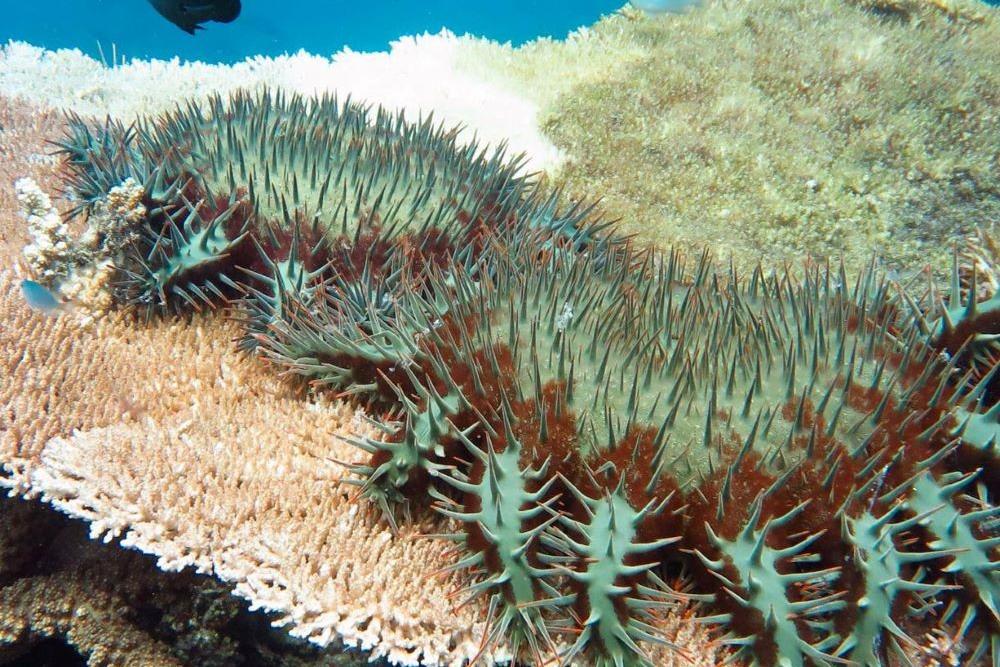
Another big concern for coral on the Reef is the crown-of-thorns starfish.

They feed on coral and are a major cause of coral decline across the Reef over the past 40 years.

To reduce their numbers, professionally trained divers manually cull the starfish by injecting them with bile salts or household vinegar.

This has helped to protect large areas of the Reef from this invasive pest.

Science is also helping us look at ways to improve our management of the crown-of-thorns starfish.

There are nearly 9000 different species of marine life on the Great Barrier Reef, including fish, turtles, whales, sharks and rays.

If you look down, you’ll see one of the six species of marine turtle that can be found on the Reef.

One of the key threats to the Reef’s marine life is pollution. This includes plastics and other marine debris.

To reduce the amount of plastics and other debris entering the Reef, Australia invests in a range of clean up events and educational programs.

This helps to protect our precious marine life – like the turtles you see nesting around you. It also ensures tourists can continue enjoying the Reef’s clean waters.

Because the Reef is so large and complex, it is important to support everyone to do their part to protect it.

Australia’s investments are empowering people to care for the Reef through strong partnerships and collaboration.

This is supporting First Nations peoples, Tourism Operators, scientists, community and a range of other partners to take action.

There’s a role for everyone. We can all do our part.

All of this work supports Australia’s Reef 2050 plan, which is the overarching framework for protecting and managing the Reef.

Australia is committed to ensuring the Reef remains one of the best managed world heritage properties.

By working together, we can protect the Great Barrier Reef.

Read more

  • The Great Barrier Reef
  • Protecting the Great Barrier Reef
  • Share on Facebook
  • Share on LinkedIn
  • Email
  • Copy link

Related

Aerial image of the Great Barrier Reef

$91.8 million boost to safeguard the Great Barrier Reef

  • News
  • Environment
22 May 2026
decorative image

Partnerships supporting Reef protection

  • News
  • Environment
20 May 2026
great barrier reef ocean

Reef 2050 Catchment Water Quality Strategy

  • News
  • Environment
15 May 2026
All news
Thanks for your feedback.
Thanks! Your feedback has been submitted.

We aren't able to respond to your individual comments or questions.
To contact us directly phone us or submit an online inquiry

CAPTCHA
This question is for testing whether or not you are a human visitor and to prevent automated spam submissions.

Please verify that you are not a robot.

Skip
dcceew energy art

Footer

  • Contact us
  • Accessibility
  • Disclaimer
  • Privacy
  • FOI
  • Copyright
Last updated: 02 December 2024
DCCEEW footer 06.02.2024

Connect with us

Facebook Instagram LinkedIn

We acknowledge the Traditional Owners of Country throughout Australia and recognise their continuing connection to land, waters and culture. We pay our respects to their Elders past and present.

© Department of Climate Change, Energy, the Environment and Water